The Birth of the Stampede Cowboy
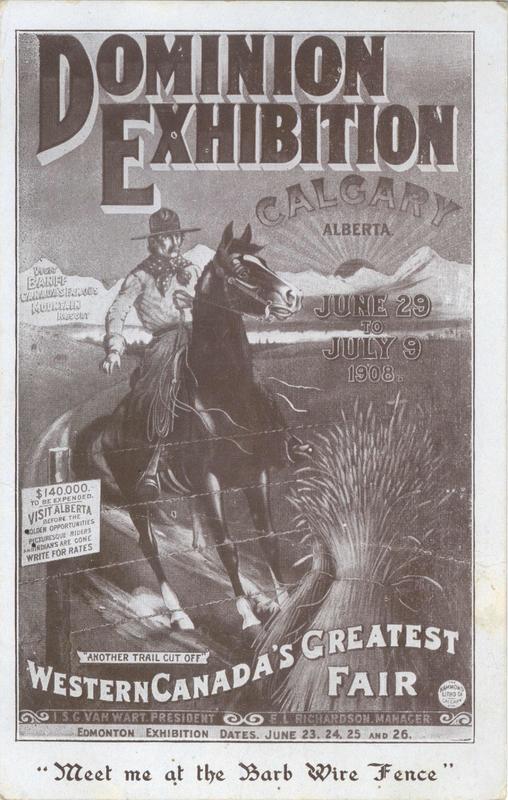
The figure of the "Stampede Cowboy" is often thought to have been born alongside the Calgary Stampede in 1912. While that may be the moment he was officially named, his true origins trace back earlier, to the 1908 Dominion Exhibition in Calgary. It was there, in the heart of a rapidly changing West, that the spirit and imagery of the Stampede Cowboy began to take shape.
The 1908 Dominion Exhibition was a major national fair, held from June 29 to July 9, and attracted over 100,000 visitors—an enormous number for the time. It featured cutting-edge industrial displays housed in Calgary's newly constructed Industrial Exhibits Building, daily airship flights, and international entertainment such as the famed Miller Brothers' 101 Ranch Wild West Show. One of the performers with that troupe was a young American showman named Guy Weadick, the eventual founder of the Calgary Stampede.
Weadick's experience at the Exhibition left a lasting impression. Calgary, at the time, felt to him like a city on the brink of modernity, but still rooted in its Old West past. This blend of nostalgia and transformation inspired his vision of a grand celebration—a "Frontier Days and Cowboy Championship Contest" that would capture the fading spirit of the Wild West before it disappeared completely beneath the plow of progress. This vision would take shape four years later as the first Calgary Stampede.
The promotional materials for the 1908 Exhibition reveal how strongly this tension between the old and the new defined the event. One visitor guide carried the tagline:
“Don’t miss this opportunity to see the Province of Alberta. Come before the Indians and Cowboys and the tremendously fascinating western life are forced far into the background by the energetic wheat farmer.”
This language reflects a powerful theme that would come to define the Stampede itself: the belief that the "wild" West was vanishing, and with it, the cowboy way of life. Calgary became a kind of living time capsule; a place where the past could still be celebrated, even as the future pushed steadily forward.
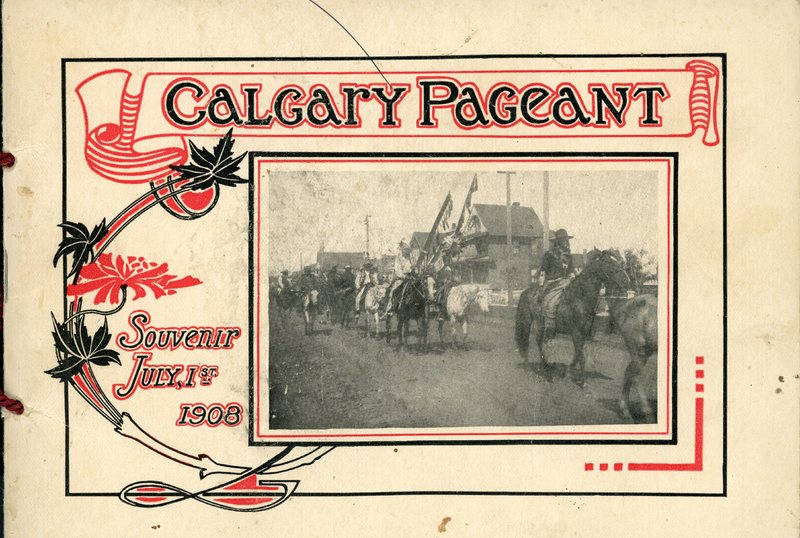
A passage from the Calgary Pageant, written to commemorate the 1908 Dominion Exhibition, captures this mindset with vivid clarity:
“The Indians were alive and most of the 2,000 in the parade had taken part in many bloody battle-fields. The early missionaries were there in person, as were the early traders, the cowboys and all the other early settlers. The coming of the newer settlers from all parts of the world was shown in a very attractive manner. An imperialist air surrounded it all, but young Canada was well represented; Scandinavia, England, Scotland, Ireland, Germany, America and all.
The rear of the parade was made up of the very modern Calgary, the city of champions, the gaudy automobile parade, gaily decorated horses, and the interesting floats of the merchants. The contrast was very striking. The pageant was declared by all who saw it as the most unique, original and interesting affair of its kind ever seen in Canada.”
This pageant and the Exhibition more broadly helped lay the cultural foundation for the Calgary Stampede. It showcased a romanticized image of a vanishing frontier while celebrating the forces of modern progress. Out of this powerful contradiction, the Stampede Cowboy was born—not just as a rodeo figure, but as a symbol of a West that was being mythologized even as it was disappearing.