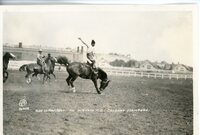
Daring Cowboys of The Dying West
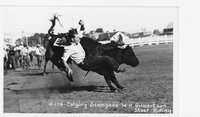
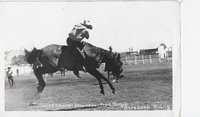
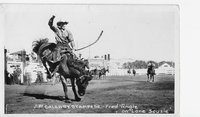
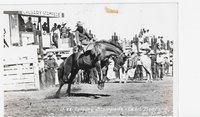
“Introducing the knight of the Range, kings of the saddle and rope: competing for Canadian and North American champion honors in picturesque, romantic and spectral contests incidental to the invasion and settlement of the great north west.”
So begins the 1928 program guide for the Calgary Stampede. Just 28 years after the height of Alberta's first ranching boom (1880s–1900s), we already see a clear romanticization of a recent past, one that many Stampede attendees would still have remembered firsthand. This opening line sets the tone for what follows: an invitation to witness a “romantic and spectral contest,” a theme that resonates throughout the programming of the event.
Alongside classic rodeo competitions, the 1928 Stampede also featured now-forgotten events such as wild cow milking and wild horse races. These spectacles helped shape a recurring motif of the cowboy as a masculine ideal: rugged, skilled, and heroic. This vision continued throughout the guide, with declarations like:
“A thrilling western jubilee impossible of repetition or imitation anywhere in the world. It’s a natural at Calgary, Alberta, the cowboy capital of the Dominion.”
Even in this more modern language, we see the same cultural messaging: Calgary as the last outpost of the “Wild West,” where cowboys are still cowboys—where, implicitly, “men are still men.” This framing of the Stampede as a site of preserved masculinity reflects a broader cultural construction of the cowboy as a version of the perfect Canadian man. Across decades of programming, the Stampede repeatedly invites audiences to step into this fading world of Western masculinity.
The mythos of the cowboy was not only celebrated in spectacle but also curated through exhibitions. Program guides from the 1930s, such as those using slogans like “The Show Window of the West” (1932) and “Exhibits of a Nation” (1933), emphasized a nostalgic portrayal of rural life. A 1930 guide listed exhibition categories such as:
- Cattle, Sheep, Swine, Horses, Poultry, Dogs
- Dairy Products, Agricultural Implements, Agricultural Products
- Government Exhibits, Plants and Flowers
- Ladies’ Work, Boys’ and Girls’ Exhibits, School Work
- Fine Arts, Art Loan, Indian Work
These displays offered visitors a curated view into a vanishing way of life. The inclusion of “Indian Work” alongside domestic arts and livestock further illustrates how diverse aspects of prairie culture were folded into a singular, romanticized narrative of the West.
By the 1950s, the theme of the “dying West” became even more pronounced. A 1956 guide reads:
“A programme of cowboy events featuring the everyday life of the hardy riders of the open range when great herds of cattle and horses roamed the prairie, unhampered by roads, bridges, or barbed wire fences, when distance was measured only by how many miles a good mounted rider could travel in a day, fording the creeks and rivers, with only an occasional butte or other landmark to serve as a guide or marker.”
This excerpt captures the nostalgia for an open, untamed land, an era perceived as ending with the advent of fences and fixed boundaries, symbolized most often by the introduction of barbed wire. The cowboy’s freedom, once defined by vast landscapes and few limits, became something of legend, preserved only in memory and performance.
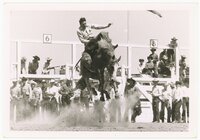
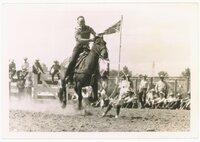
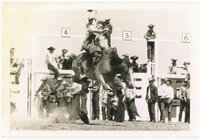
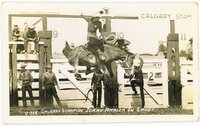
Perhaps the most pointed articulation of this romantic ideal appears in a 1959 article from a Stampede visitor guide titled “The Stampede or Rodeo Cowboy is Really Quite a Character.” The piece attempts to define the cowboy, presenting a figure who is both mythic and oddly specific:
“As a bachelor, he’s a gay blade, living it up from Boston, Mass., to Barstow, Cal. But as a family man with an average of three children he’s a good husband and a fond father, who often drives 1,000 miles out of his way between rodeos to spend one day at home with his wife and kids.”
The article continues with a list of cowboy traits, painting a vivid, if maybe heavily stylized portrait:
“He drinks – bourbon and sweet or straight — and he smokes. But most often on the ranch or the arena he chews.”
“He curses like a man should but never in front of a lady.”
“He’s polite with ladies and strangers, but a tiger when wronged and a mighty tough man to fight.”
These characterizations reveal how the Stampede did more than simply celebrate rodeo sport; it actively crafted and sustained a cultural archetype. Through evocative language, nostalgic exhibitions, and constructed imagery, the Calgary Stampede not only preserved the skills and thrills of the cowboy but also elevated him to a folkloric status.
Ultimately, the Stampede became more than an event; it evolved into a powerful cultural narrative—one that immortalized a uniquely Canadian vision of masculinity, heritage, and the fading frontier. The cowboy, as imagined by the Stampede, was not just a historical figure but a symbolic one—standing at the intersection of nostalgia, nationalism, and myth.
![Casey Patterson on Una [sic], 1928](https://s3.amazonaws.com/omeka-calgarystampede/thumbnails/c1a91598023f892c530a4aa2456a962b.jpg "Casey Patterson on Una [sic], 1928")